


Basic Rules
Basic Rules
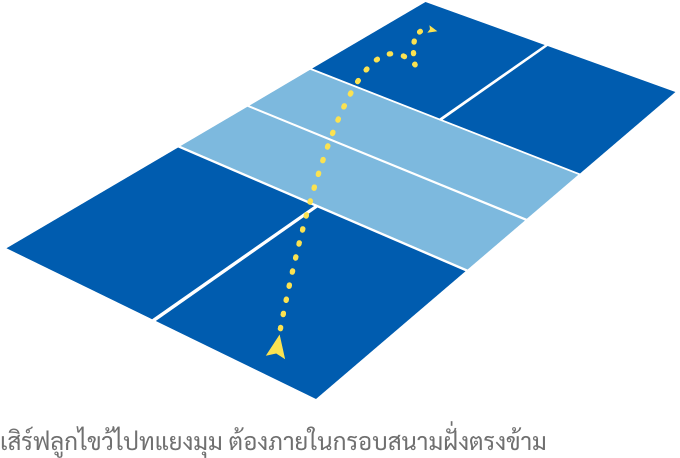
1.Pickleball Serve Rules
- The server’s arm must move in an upward arc when striking the ball.
- Contact with the ball using the paddle must not be made above waist level.
- The paddle head must not be higher than the highest part of the wrist at the moment of contact.
- A “drop serve” is allowed and does not need to follow the requirements above.
- When serving, the server’s feet must not touch the court or the area outside the sidelines and centerline extension. At least one foot must remain behind the baseline, either on the court surface or behind the baseline area.
- The serve must be made diagonally across the court and land within the opposite service area.
- Only one serve attempt is allowed per player.
2.Serving Sequence
- In doubles play, both players on the serving team have the opportunity to serve and score points until they commit a fault (except for the first service sequence of each game).
- The first serve of each side-out begins from the right/even side.
- If a point is scored, the server switches sides and serves again from the left/odd side.
- As additional points are scored, the server continues switching sides until a fault is committed and the first server loses the serve.
- Once the first server loses the serve, the partner serves from the correct side of the court (except during the first serving sequence of the game).
- The second server continues serving until the team commits a fault and loses the serve to the opposing team.
- When the serve passes to the opposing team (side-out), the first serve always starts from the right/even side, and both players on that team have the opportunity to serve and score until two faults are committed.
- In singles play, the server serves from the right/even side when their score is even, and from the left/odd side when their score is odd.
- At the start of each game, only one player on the serving team has the opportunity to serve before a fault results in the serve going to the receiving team.
3.Scoring
- Only the serving team can score points.
- Games are normally played to 11 points, and the winning team must lead by at least 2 points.
- In tournament play, games may be played to 15 or 21 points, with a required 2-point lead to win.
- When the serving team’s score is even (0, 2, 4, 6, 8, 10), the player who served first in that game will be on the right/even side when serving or receiving.
- When the serving team’s score is odd (1, 3, 5, 7, 9), the player who served first in that game will be on the left/odd side when serving or receiving.
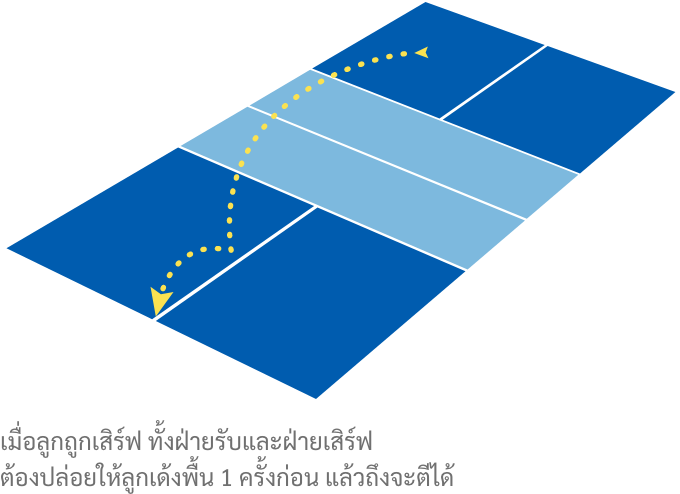
4.The “Double Bounce” Rule
- After the ball is served, both the receiving team and the serving team must allow the ball to bounce once before hitting it.
* First bounce: the receiving side lets the serve bounce before returning it.
* Second bounce: the serving side lets the return bounce before hitting it back. - After these two bounces, volleys (hitting the ball before it bounces) are allowed, except inside the “Kitchen” zone.
5.The Two-Bounce Rule
- After the serve, the receiving team must return the ball only after it has bounced once on their side of the court.
- Then, the serving team must return the ball only after it has bounced once on their side of the court.
- This sequence creates the required two bounces.
- After the ball has bounced once on each side, both teams may either volley the ball (hit before it bounces) or hit groundstrokes (after the bounce).
- The Two-Bounce Rule helps reduce the serving team’s advantage and encourages longer rallies.
6.Non-Volley Zone
- The Non-Volley Zone is the area within 7 feet on both sides of the net.
- Players are not allowed to volley the ball while standing inside the Non-Volley Zone. This rule prevents players from smashing the ball too close to the net.
- It is a fault if a player steps into the Non-Volley Zone while volleying, including touching the boundary line, or if the player’s momentum causes any part of their body, clothing, or equipment to touch the zone or its lines.
- It is also a fault if, after volleying, a player is carried by momentum into or touches the Non-Volley Zone, even if the volleyed ball has already been declared dead.
- Players may legally stand inside the Non-Volley Zone at any other time, as long as they are not volleying the ball.
7.Line Call Rules
- A ball touching any part of any line — except the Non-Volley Zone line during a serve — is considered “in.”
- A serve that touches the Non-Volley Zone line is considered short and is a fault.
8.Faults
- A fault is any action that stops play due to a rule violation.
- A fault by the receiving team results in a point for the serving team.
- A fault by the serving team results in loss of serve (side-out).
9.Methods for Randomly Choosing the First Serving Team
- Any fair method may be used to randomly determine which player or team chooses sides, serves first, or receives first.
- Example: Write the numbers 1 or 2 on the back of the score sheet and randomly draw one.